


Vibe Code Your IoT Fleet with the ShifuDev CLI
Describe what you want to build. Watch your AI coding agent build it.
Vibe coding works brilliantly for web apps. You describe what you want, the AI builds it, you refine, you ship. The loop is fast and the results are real.
For IoT, that loop breaks. You describe what you want. The AI asks what device you're using. What protocol. What endpoints. What the service URL is. You dig through docs, copy-paste answers, and suddenly you're not vibe coding anymore — you're the integration layer between your AI and your hardware.
Today that changes. The ShifuDev CLI brings vibe coding to the physical world.
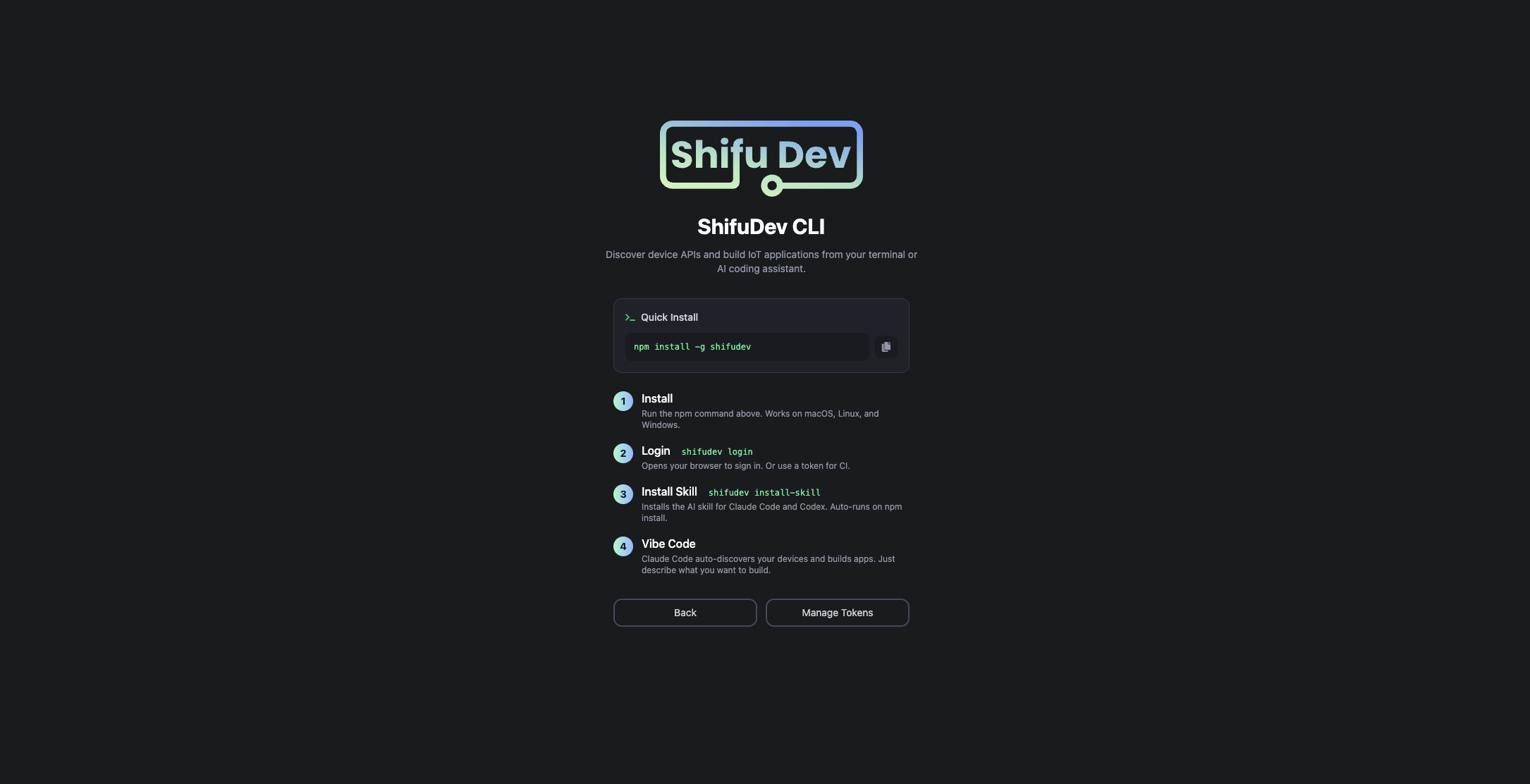
Install
npm install -g shifudev
shifudev login
shifudev install-skill
That's it. install-skill wires your AI coding agent directly into your ShifuDev device fleet. From that moment, every session starts with your agent already knowing your devices.
What Vibe Coding IoT Actually Looks Like
Open a new session with your AI coding agent. Say: "Build a live dashboard that shows temperature and humidity from all my sensors."
Your agent runs shifudev device list. It sees your sensors. It runs shifudev device describe on each one — gets the service URLs, the endpoints, the read/write flags. It writes the code. It deploys it to your edge cluster. You watch a dashboard appear.
You didn't describe a single endpoint. You didn't look up a single service URL. You didn't explain what protocol your sensors use. You described the outcome you wanted, and the AI handled the rest.
That's the version of IoT development this industry has been waiting for. Vibe coding, but for the physical world.
Why This Wasn't Possible Before
AI coding agents are brilliant at building software — when they have context. For web apps, that context is the codebase. For IoT, the context is your device fleet: what's deployed, what endpoints exist, what protocols are running, where services live in the cluster.
Without that context, the AI is guessing. With the ShifuDev CLI installed, it isn't. shifudev install-skill gives your coding agent a skill that runs device discovery automatically at the start of every session — no prompting required. The agent goes from "what device?" to "I see your 12 devices, here's the dashboard" in seconds.
The Vibe Coding Loop, End to End
Describe it:
"Monitor my production line — alert me when the conveyor motor temperature exceeds 80°C."
Your agent discovers:
shifudev device list        # finds your motor sensor
shifudev device describe motor-sensor-01 -o json  # gets the endpoint, service URL, read interval
Your agent builds: a monitoring service, deploys it to the edge cluster, wires up the alert logic.
You iterate: "Make the threshold configurable from a web UI." Done. "Add a 5-minute rolling average." Done.
The hardware is already there. The integration is already there. The only thing left is describing what you want.
Build Whatever You Want
ShifuDev isn't a command you run — it's a skill your AI coding agent already has. There's no CLI to learn, no integration to wire up, no debug loop to manage. Your agent discovers your devices, writes the code, and deploys it. You describe outcomes.
Open your AI coding agent. Describe what you want to build. Your devices are already in context.
Ship the thing.
Want to see it working on your own device fleet? We will walk you through it live.
For technical details, see the ShifuDev product page.

